Original article: Dr Sara Llorens, translated with AI.Read the original in Spanish
Dragons in the clouds
We see dragons in the clouds because the mind hunts for patterns. Heuristics and biases explain why it pays not to believe everything you think.
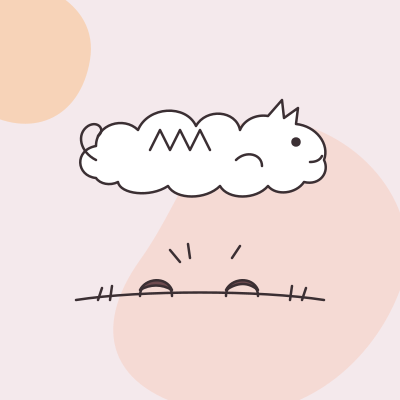
Javi and Luis are lying on the grass, laughing, playing and making the most of the last days of the holidays before going back to school. Suddenly Javi shouts: “Hey, look, a dragon in the sky!” “And look over there! It looks like a wolf’s face,” Luis replies. This phenomenon is called pareidolia, and it happens with clouds, stains and countless other things. It’s one example among thousands of how our mind is designed to look for patterns to make sense of what’s around us, saving energy and time and reducing uncertainty, which gives us a false sense of safety and control. We tend to look for logic in everything around us, and that “logic” will always be shaped by our wishes, priorities, needs, beliefs, current worries… Which often leads us to make the wrong connections. That happens because we aren’t really rational information processors; we’re fast information processors. Which isn’t the same thing. Our reasoning is full, absolutely full, of biases: errors that shape how our mind processes everything that happens in our lives.
Biases and heuristics are two terms that mean different things, but both shape our reasoning, our perception of the world and, as a result, the way we feel and act. Heuristics are thinking rules we apply to decide in situations where uncertainty is high or where we simply have to make a quick decision. Heuristics can lead us to the right answer or to a mistake. Biases, on the other hand, are reasoning errors we all commonly make. So when we apply a bias, we’re going to get it wrong, no matter what.
Focusing on heuristics, there’s one in particular that has a big influence on our daily lives: the availability heuristic. Basically, it means believing that the information we recall most easily is the most important, the most frequent or the most relevant when acting or deciding in a particular situation. For example, we remember plane crashes more easily (and so we’re more wary of flying) because they get more news coverage and are given more weight than car accidents. In reality, though, plane crashes are vastly less common than car crashes. Another example is the news itself. What do we usually hear or read in the news? Everything that’s going wrong in the world. That’s why most people think the world is going from bad to worse and that, basically, we’re in free fall. Yet according to the research, the world hasn’t got worse; it has actually improved in many of the areas where we believe the opposite. So why do we tend to think otherwise? Because of the availability heuristic: the information we have most access to is negative. A couple of days of listening to the news is enough to lose faith in humanity. Good news doesn’t sell as many papers, and like it or not, that’s the reality.
We’re also wired to believe more easily anything that feels familiar or fits with what we already believe. And when new information doesn’t fit our mental schemas, we tend to spin a story or line of reasoning until we’ve convinced ourselves the new information isn’t valid, and so we stay settled in our usual beliefs and ways of thinking. Obviously this doesn’t happen all the time, but we do slip into it easily. If you want to revisit that part, I recently wrote about cognitive dissonance and confirmation bias, which shape our day-to-day lives, sometimes helping us and sometimes not so much. Yet more proof of how biased our reasoning is and how irrational (though generally effective) it can often be.
Another way to show we’re far from being rational information processors is the bias known as imagination inflation, which basically means that the more we imagine something, the more likely we are to believe it really happened. In fact, many techniques for inducing false memories are based on this bias. That’s why great care and rigour are needed when using psychoanalytic strategies aimed at bringing possible repressed memories to light, because the mind can sometimes play very nasty tricks on us.
These examples are just a few of the many rules and distortions that govern how our mind reasons about everyday information. We’re designed to process information as efficiently as possible. In other words, processing well matters, but processing fast is also essential, and speed often comes with a few errors. Even so, we’re good processors, because we’re still here, so we can’t be doing that badly…
If you’re interested in the subject, have a look at Por qué creemos en mierdas (roughly, “Why we believe in crap”) by Ramón Nogueras. The book has very good content, explained in an entertaining way with examples from everyday life, so it’s easy to follow. When I recommend reading in these articles I always try to choose books that aren’t too technical and that teach us interesting things we can apply, or at least reflect on. This book fits the bill.
A final conclusion we all already know and still need to remember every day:
Careful about believing everything I think, because I’m sure, absolutely sure, I’ll be wrong.