Original article: Dr Sara Llorens, translated with AI.Read the original in Spanish
Are Antidepressants as Safe as They Say?
A summary of a scientific paper that questions how effective and safe antidepressants really are, and how serotonin relates to depression.
In this article I’m going to summarise the main points of a very interesting paper on antidepressants that questions both the effectiveness and the safety of this kind of medication. The paper is called Primum non nocere: an evolutionary analysis of whether antidepressants do more harm than good, by Andrews, Thomson, Amstadter and Neale, published in 2012 in the journal Frontiers in Psychology (doi: 10.3389/fpsyg.2012.00117). Bear in mind that it’s a paper from a few years ago that puts forward a hypothesis from an evolutionary perspective, and that important studies on the subject have been published since (I’ll tell you about them at the end). If you’re interested in the subject, I encourage you to look it up and have a read. Here I’ll give you a short summary of what I think are the key points. Let’s go.
Depression is one of the most common mental disorders, which translates into a huge worldwide demand for antidepressant drugs.
Serotonin and norepinephrine are the main neurotransmitters involved in depression. To put it simply, they’re substances in our central nervous system (our brain) which, according to current theories of depression, are responsible for regulating depressive symptoms. Antidepressants are the drugs that regulate these substances and supposedly improve depression. This kind of medication isn’t only prescribed to people with depression, but in many other cases too: dysthymia, bipolar disorder, obsessive-compulsive disorder, eating disorders, anxiety disorders… In other words, a high percentage of the world’s population currently takes antidepressants for one reason or another.
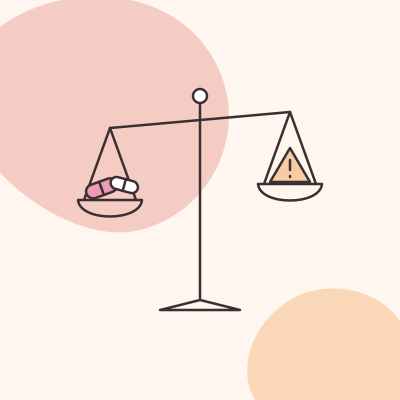
Let’s say the main reason for so many prescriptions across all five continents is that antidepressants are, in principle, assumed to be effective as well as harmless, but some studies have suggested that this isn’t so clear-cut and that much more research is needed. The studies the authors review suggest that, in many patients, the antidepressant effect of these drugs is only somewhat greater than that of a placebo and – just as important, if not more so – that they can produce adverse effects that need to be taken into account.
Until now, it had been said that antidepressants promote neurogenesis (the formation of new neurons), but it seems this isn’t so clear either, and they could lead to the opposite: neuronal death. According to some studies the authors cite, carried out mainly in animals and in the laboratory, antidepressants could cause neuronal damage and revert mature neurons to more immature stages, and the authors propose that this could drive some neurons towards programmed cell death (apoptosis). This hypothesis has not been demonstrated in humans.
They’re also known for their sexual side effects. In addition, the authors cite studies linking their use to a higher risk of bleeding (including a small increase in the risk of some types of stroke), attention problems and digestive problems, although these are mostly observational associations and, in the case of stroke, the absolute risk is low. According to the authors, all of this would be the result of the disruption these drugs cause in the adaptive serotonin system (I’ll explain this system below). The biggest problem in our society in this respect is that antidepressants are handed out like sweets, underestimating the adverse effects that taking them may bring.
The main way antidepressants work is by keeping serotonin in the synaptic gap for longer. To put it simply, between neuron A and neuron B there’s a tiny space through which they connect. Neuron A releases serotonin which, once it has done its job (one of its functions is regulating mood), is picked up by a transporter that stores it back in neuron A. Antidepressants block these transporters, so serotonin stays active in that synaptic gap for longer than usual. According to the authors, when antidepressants are taken over a long period, the brain would tend to produce less serotonin to compensate for their effect. In other words, the body does what it always does: it seeks balance (homeostasis). This could be the reason for the many medium- and long-term relapses in people with depression for whom antidepressants did work at first.
Those of us who work in pharmacy, psychiatry and/or psychology know that the main hypothesis explaining the onset and persistence of depression links serotonin and other neurotransmitters to depressive symptoms, but we also know that the exact nature of this link isn’t so clear. To put it simply, it hasn’t been proven that a drop in serotonin is a direct cause of depressive symptoms.
We have to bear in mind that antidepressants generate enormous profits for the big pharmaceutical companies. When money is involved, there’s a conflict of interest. And health is no exception. I say this because there are studies comparing placebo with antidepressants in people with depression in which the difference in improvement between the two groups is small. And for years many of these studies went unpublished (you’ll find the details in the paper). Some authors see the low effectiveness of antidepressants as proof that serotonin isn’t involved in regulating depressive symptoms.
This paper raises many questions but, above all, it makes clear how much we still have to learn, even in areas where we thought we already knew enough.
That said, the debate has moved on since it was published. The largest analysis carried out so far (Cipriani et al., 2018, The Lancet, 391(10128), 1357-1366; doi: 10.1016/S0140-6736(17)32802-7), which pooled 522 trials with more than 116,000 adults with major depression, concluded that all 21 antidepressants studied were more effective than placebo in acute treatment, although the average effect was modest and there were differences between drugs. In other words, antidepressants do work better than placebo, but they’re not a cure-all: that’s why it’s important to assess each case carefully, explain the possible side effects and combine them, when appropriate, with psychotherapy.
Important: if you take medication, don’t stop it or change the dose on your own. Any change should be made with your doctor or psychiatrist.