Original article: Dr Sara Llorens, translated with AI.Read the original in Spanish
Our third brain: the heart
The heart has its own neurons and talks to the brain through the vagus nerve. What research says about heart-brain coherence and your emotions.
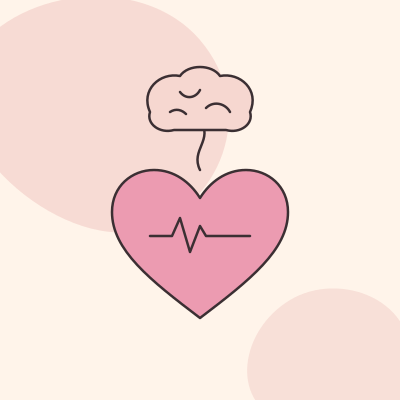
The stomach (in fact, the whole digestive tract) is considered our “second brain” and contains neurons that act independently of the neurons in the brain.
No less than 90% of the serotonin in our body is found in our digestive tract. When our brain releases serotonin, we feel happiness and wellbeing. However, this substance also regulates hunger and fullness, which is why there’s so much of it in the gut. The brain and the digestive tract communicate in both directions through the vagus nerve, so what happens in one affects the other and vice versa. In other words, what you eat, how your gut processes it, even the kind of gut flora your body has… all of this is information that travels to the neurons in your brain, which are affected by it and in turn send information back to your gut. When we talk about “butterflies in the stomach”, “a knot in the stomach” or being “scared shitless”, these aren’t just figures of speech: they reflect a real physiological process. My brain sends signals to my stomach to increase or decrease gut motility, producing these sensations.
But today I don’t want to write about our second brain but about the third: our heart. The heart contains roughly 40,000 neurons and is also connected to the brain, in both directions, through the vagus nerve. We know that the heart doesn’t just take orders from the brain: it also sends it a great deal of information, and many of the nerve fibres connecting them run from the heart to the brain. Some researchers (especially those at the HeartMath Institute in the United States) describe four channels of communication running from the heart to the brain and influencing it:
-
Neurological communication through nerve impulses. The heart can inhibit or activate certain parts of the brain, thereby influencing how we process the information around us and, as a result, how we react.
-
Biochemical communication through hormones and neurotransmitters. For example, the heart can produce and release oxytocin (the “love hormone”) or atrial natriuretic peptide, a hormone that helps regulate blood pressure.
-
Biophysical communication through pressure waves. The heart sends messages to the brain and the rest of the body through the heart rhythm and its variations (heart rate variability).
-
Electromagnetic communication. The heart generates the strongest electromagnetic field in the body (much stronger than the brain’s), and it can be detected at some distance from the body with very sensitive equipment. According to these researchers, when we feel fear or stress the heart’s rhythm becomes more chaotic, and they suggest that its electromagnetic field could influence brain activity. It’s an interesting hypothesis, but for now this channel of communication has little evidence behind it.
Some of these authors go further and suggest that we process the information around us first through the heart and then at the level of the brain, although research has not yet confirmed this idea.
It seems that our heart rhythm forms broad, stable waves when we have positive thoughts and good emotional regulation. However, it becomes more chaotic when our thoughts are negative and we have negative emotions. What’s striking is that, according to these researchers, either rhythm would produce changes in brain waves, which would tend to synchronise with it.
Another very interesting idea (to me, at least) put forward by some authors is that the information processed by the heart wouldn’t take our memories into account, so our perception of reality through the heart wouldn’t be as distorted by past experiences, and the heart would provide the brain with information about the environment at other levels. It’s an appealing hypothesis, but at present there are no studies that prove it.
Another interesting finding is that studies link high heart rate variability (not a high heart rate) with higher levels of concentration, memory, verbal fluency and emotional and cognitive skills in general. It seems that when we feel joy, heart rate variability increases. In fact, scientific studies have found that diseases such as Alzheimer’s are associated with low variability. However, it has also been reported that in Tibetan monks who are expert meditators, the brain-heart connection decreased during meditation, as if the heart were trying to quieten the brain while meditating. So what does that mean? We should seek what is known as heart-brain coherence, which according to some authors would result in the fullest expression of our emotional, cognitive and biological potential (an appealing concept, though still under study). Practising gratitude, simplicity, patience, mindfulness and introspection are good ways of moving towards this coherence.
Another study, carried out by researchers at the University of Cambridge with traders on a London trading floor (Kandasamy and colleagues, 2016, published in Scientific Reports), found that those who were better at perceiving their own heartbeat made more money and lasted longer in the profession. This could suggest that signals from the heart provide useful information when we make decisions, although it doesn’t mean the heart “knows” the outcome in advance. In line with this study, one hypothesis experts are considering is that people with good interoception (our ability to listen to the signals our body sends us) might make better decisions than those with poor interoception, since the former would be better able to listen to their heartbeat. Once again, mindfulness would be a very useful practice for increasing our interoceptive ability. Many scientific studies link mindfulness practice with lower stress, greater wellbeing, better emotional management… and many other benefits.
On another note, and related to all of the above: sometimes our brain “switches off”, disconnecting for a few milliseconds. This is known as the “attentional blink”: when we have to detect two stimuli in quick succession, we often miss the second one. Some authors have linked these “blackouts” to communication between brain and heart, although there is no evidence that they are caused by a disconnection between the two. What several studies have found is that what we perceive and remember varies depending on the point in the heartbeat at which a stimulus reaches us. In other words, communication between brain and heart also seems to influence how we perceive the world around us.
This is a short summary of some of the studies and hypotheses (some still to be confirmed) put forward in neuroscience in recent years, which explain why the heart has gone from being seen as a mere pump to being in the spotlight for neuroscientists all over the world.
I find this a fascinating topic, so we’ll come back to it sooner rather than later…