Original article: Dr Sara Llorens, translated with AI.Read the original in Spanish
Paradoxical Intention vs. Thought Stopping
Postponing rumination or trying to suppress it: why paradoxical intention can help with OCD and anxiety, while thought stopping simply doesn't work.
Some time ago I told you about a therapeutic strategy called paradoxical intention (PI) but, if I remember rightly, I’ve never written about thought stopping (TS). Both have supposedly been used to treat obsessions or rumination. When I talk about obsessions or rumination, I don’t just mean obsessive-compulsive disorder (OCD), which is a regular in these articles, but rumination in general: those thoughts that come in spirals, that I go over and over endlessly, that cause me distress and never lead to a lasting conclusion or solution. And that, on top of that, interfere with whatever I’m doing. Those are the ones I mean.
Well, I tend to use PI as one more strategy in certain cases. I never use it as the main strategy. PI usually works well, though not for every client, and it has to go hand in hand with other core strategies (exposure, behavioural experiments, Socratic dialogue…). Remember that the aim of PI is to postpone thoughts, not to suppress them. In other words: “Fine, I’ll give myself permission to go over it, but later, at the time I’ve set aside for it.” On the one hand this lets me focus on what I’m doing at that moment and, on the other, it lets me see that, most of the time, what I thought was urgent stops being so after a few hours.
I use it for OCD, generalised anxiety disorder, and with people who simply have a high level of anxiety about one or more specific issues…
A note on the name: what I’ve just described (giving myself permission to worry, but later, at a time of day set aside for it) is more accurately known as worry postponement (or “worry time”). Paradoxical intention in the strict sense, as proposed by Viktor Frankl, is a different technique: it involves deliberately seeking out, or even exaggeratedly wishing for, the very thing you fear, instead of trying to avoid it. In this article I’ve kept the term “PI” that I’d been using, but it’s worth knowing that the technique I’m talking about is worry postponement.
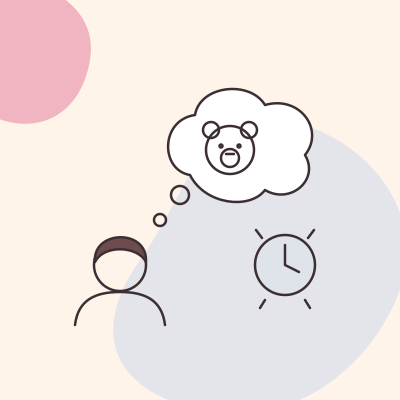
TS is a different story. I never use it, because it’s a strategy that was once considered effective but which, over time and with the relevant research, has been shown not to be. TS is based on suppressing (not postponing) negative or anxiety-provoking thoughts. In other words, forcing myself not to think about whatever is distressing me. It works by pairing a negative thought with a small punishment (the classic example is a rubber band around the wrist that I snap every time the unwanted thought appears), with the aim of gradually reducing how often that thought appears (operant conditioning, pure and simple). This usually doesn’t work, because research has shown that when we try to suppress thoughts that make us anxious, they come back even stronger. The brain responds along the lines of: “Don’t want it? Here, have a double helping!” The classic example of this rebound effect goes like this: “For the next hour, you can’t think about a white bear. Think about any animal, object or person you like, anything that comes to mind. Except a white bear.” From what I’ve explained, you can guess what happens.
Is there really that much difference between the two? Yes, because one delays the moment and the other tries to suppress it. The first is difficult, but the second is harder still, because it requires something human beings don’t have: total control over our thoughts. We’ve talked about this before: controlling our mind is an illusion (and many disorders stem from that illusion), all the more so when we’re anxious, because then we’re more vulnerable, since our cognitive resources are (temporarily) reduced by anxiety, or we simply use them in the wrong way. So if a person with no psychological problems at all is bound to fail when trying to control 100% of what goes through their head, imagine someone with some kind of problem, in a vulnerable state.
Conclusion: strategies aimed at suppressing or getting rid of thoughts in anxious states won’t be useful to us and will only frustrate the client further. Let’s take note.