Original article: Dr Sara Llorens, translated with AI.Read the original in Spanish
The butterfly's lesson
Like a butterfly that must struggle out of its cocoon, everyone has their own pace of change. Why forcing it, in life or in therapy, rarely works.
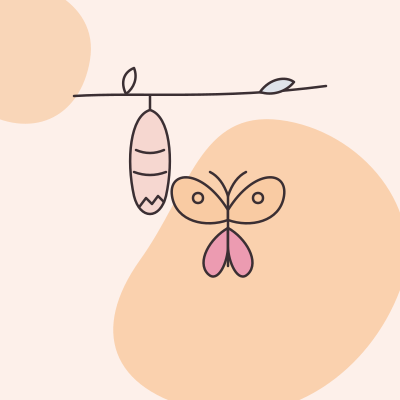
I came across this text months ago (as far as I know, the author is unknown) and saved it, meaning to write one day about the message it carries. It tells the story of a traveller who sees a butterfly straining to get out of its cocoon and, wanting to help, cuts it open to spare it the effort. The butterfly emerges too soon, with crumpled, feeble wings, and never manages to fly: that struggle was exactly what it needed to be ready.
We human beings are malleable, some more than others, but all of us are. We can all change if we want to and put in the effort. That is the very basis on which therapy exists, and on which life makes sense. By now I think most of us understand life as a process of constant change, both of ourselves and of our circumstances. But for that change to be possible, you have to be ready for it and respect your own pace, which doesn’t have to be anything like your neighbour’s. Respecting our pace means respecting our own process of change. Applying pressure when you’re not ready, whether it comes from yourself or from others, tends to lead to unwanted results.
My pace isn’t yours, and that’s fine. Walking alongside someone in their process of change (in life or in a therapy room) is different from pushing them to move at the pace I think is right for them. Because the pace I think is right is the product of my experiences, my character, my wishes, my circumstances, my worries, my needs… and I can’t and shouldn’t project them onto someone else, because they aren’t theirs, they belong to me. Like the traveller in the story who, with the best of intentions, tried to force the butterfly’s pace before it was ready. If I impose, I’m not respecting. And imposing very often comes loaded with good intentions, but that doesn’t make it any wiser. In fact, when we try to force someone into a pace of change that isn’t theirs, we’ll probably end up pushing them away, because they’ll end up feeling misunderstood, pressured and emotionally distant.
Exactly the same thing happens in therapy as in life: you have to respect the patient’s pace and accompany them through the process while encouraging them to move forward. And what if the patient’s pace turns into permanently standing still? In those cases, we need to look at what’s going on, and perhaps reconsider whether this is really the right time to start or continue therapy, or whether the goals we’re setting are right for this moment. It’s worth pointing out that this “standing still” can happen clearly and directly, but also indirectly and subtly through different kinds of self-sabotage. For example, I remember one patient who always used her sessions to talk about other people and situations that had little to do with why she was in therapy. However often I tried to steer her back, she always wandered off in other directions; another patient always found excuses not to do the homework and cancelled many sessions at the last minute; another belonged to a kind of “association” (for want of a better word) whose teachings, principles and guidelines were diametrically opposed to the goals of the therapy we were trying to carry out… On these occasions and a few others, I’ve had to rethink the therapy and put on the table the possibility of taking a break and reflecting on why we were there. Most of the time, this has coincided with one of two situations:
- The patient was coming to therapy because a family member had made them (the person’s pace wasn’t being respected).
- The patient was forcing themselves to make decisions or take steps they clearly weren’t ready for at that moment (they weren’t respecting their own pace).
On the first situation (1): it’s always worth remembering that the time for therapy isn’t when parents, partners, friends… decide it is. While it can sometimes be useful, that’s rarely the case. The time to start therapy is when the person decides to do so of their own free will (obviously, that doesn’t stop the people close to them from encouraging them and making it easier, but the decision has to be the patient’s own). Because if there’s no real motivation and will on the patient’s part, there’s nothing to be done. The time to start therapy is when the person feels ready to give it a try; that’s when we have a chance.
On the second situation (2): knowing rationally that something has to change or be different doesn’t mean you’re ready to take that step. Preparing yourself emotionally to take an important step takes time and a lot of effort directed the right way. Forcing ourselves into something before we’re ready increases the chances of failure, and that’s something to bear firmly in mind in any therapeutic process too.
Just like the butterfly in the story, we need our own time, space and the right obstacles to overcome in order to become a better version of ourselves. Experience has taught me that the most spectacular changes very often happen little by little, through small, barely noticeable but constant changes, like dripping water slowly forming an impressive stalagmite. So the next time we’re talking to someone and feel the urge to tell them what we think they should do or how they should do it (especially if nobody has asked us), let’s stop and ask ourselves whether what we’re about to recommend, or in some cases impose, really takes into account the other person’s process and emotional situation.