Original article: Dr Sara Llorens, translated with AI.Read the original in Spanish
Cassandra Affective Deprivation Disorder
What Cassandra Affective Deprivation Disorder is, why the neurotypical partner of someone with Asperger's suffers it, and where the name comes from.
Note: since the DSM-5, Asperger’s syndrome has been included within autism spectrum disorder (ASD). I keep the term in this article because it’s the one many people still use.
A few months ago I wrote about the story of Anna and Ben, a couple made up of a neurotypical woman (outside the autism spectrum) and a man with Asperger’s syndrome. In case you’re not familiar with it, Asperger’s syndrome is a developmental disorder on the autism spectrum. Its main features are: difficulty identifying and expressing one’s own emotions, as well as recognising other people’s and acting accordingly; as a result, great difficulty with social relationships; very formal language that isn’t adapted to different everyday situations; marked rigidity of thinking; great difficulty adapting to change; and a tendency to focus on certain topics to the point of obsession. People with Asperger’s may be intellectually gifted, but that isn’t always the case. Asperger’s syndrome has a neurological basis, so it doesn’t go away the way depression, OCD or anorexia nervosa can. It’s a lifelong condition, a different way of perceiving the world, not an illness.
It has long been wrongly believed that people with Asperger’s aren’t interested in friendships and/or romantic relationships, but over the years this has been shown not to be true. Many do want to socialise and have relationships; they just don’t know how. In fact, they don’t only get together with other people with Asperger’s: they can also form relationships with neurotypical people, as Anna and Ben did. However, for any relationship to be healthy, the person with Asperger’s has to accept their condition and act accordingly so that the necessary aspects can be worked on. Whoever is in a relationship with someone with Asperger’s syndrome will also need some psychoeducation on the subject, so they know how to handle the different situations that come up. Because no, the person with the diagnosis can’t ignore it, and neither can their partner, friend or relative. If they do, there will be problems everywhere. And one of them is Cassandra Affective Deprivation Disorder (CADD).
This concept was put forward by Maxine Aston, a specialist in therapy for couples in which one partner has Asperger’s. It’s worth making clear that CADD (also known as Cassandra syndrome) is not a recognised diagnosis: it doesn’t appear in the DSM-5 or the ICD-11, and research on it is still scarce. It’s better understood as a descriptive label that helps put a name to a very real distress. CADD can arise in many relationships involving a person with Asperger’s or any other condition that comes with alexithymia (in case you don’t know the term, it refers to difficulty or inability to put one’s own emotions into words), especially if the person doesn’t take responsibility for their condition or hasn’t been diagnosed. CADD affects the neurotypical person, usually the partner, but it can also occur in the parents, friends or siblings of someone with Asperger’s syndrome.
So what does CADD involve?
Those who describe it point above all to anxiety, depression and low self-esteem, but there may also be other symptoms such as drowsiness, reduced libido and mood changes.
Why is it called that?
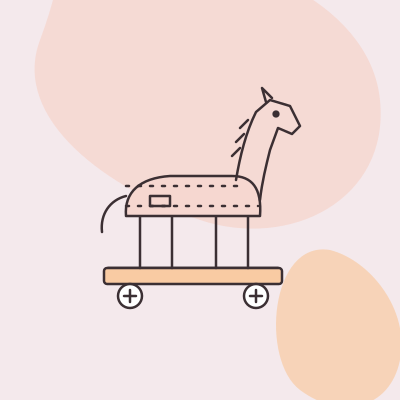
Very often, the partner who doesn’t have Asperger’s isn’t believed by their partner (who doesn’t accept or doesn’t know about their condition) or by the people around them; this is when CADD is at its worst, with feelings of confusion, loneliness and despair. Cassandra was the daughter of Priam, King of Troy. Apollo gave her the gift of prophecy to win her over. She rejected him, and he took his revenge by letting her keep her gift but making sure no one would ever believe her: she warned of the danger posed by the Trojan Horse, but nobody believed her. Hence the name of the disorder.
If relationships between two neurotypical people are complicated enough, when both can express their own feelings and have the natural ability to recognise and respond to the other’s, imagine a couple in which one of them doesn’t have that ability naturally… Then add to that the fact that they don’t take responsibility for it, or that it has simply never been identified… This makes the situation extremely difficult. A partner, a mother, a father or anyone who wants to build an emotional bond with a person with Asperger’s is going to suffer a great deal if there isn’t a clear diagnosis that the person themselves accepts. Only then can we teach the other partner, or whoever is involved, how to interpret and respond to the different situations that may arise. What they can ask of someone with Asperger’s syndrome and what they can’t. What they can expect and what they shouldn’t. How to handle them in particular situations. And, above all, to stress that if the person with Asperger’s does or says something hurtful, it’s very likely not intentional. If both partners accept that the syndrome is there, then CADD can be worked on and can disappear. Or simply never arise at all.
If you’d like to learn more about autism spectrum disorders (ASD) in an entertaining way, take a look at the series Atypical. Informative and endearing at the same time.
[[video:https://www.youtube.com/embed/5QMwZX5DLKg?feature=player_embedded]]