Original article: Dr Sara Llorens, translated with AI.Read the original in Spanish
Disconnect to Connect: The Fear of Being Alone with Ourselves
Ten minutes a day alone with your mind, no phone, no distractions. A simple exercise that many people dread, and a key step towards truly knowing yourself.
There’s a small exercise I like to set when I’m not sure what we should be working on and we’re clearly not dealing with any kind of disorder as such. I usually find myself in this situation when the information a client gives me in sessions doesn’t match the goals we set during the assessment, and/or I notice they try to fill the sessions talking about everything and everyone except themselves. Also when they tell me they feel bad but don’t know where the problem lies and can’t capture it in their records either; or when they tell me outright that they run away from themselves and from looking at anything that happens to them.
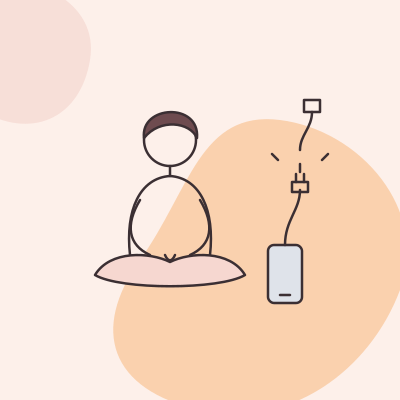
In these cases I usually ask for an exercise that may seem very easy at first, but depending on who you ask, it can be quite a challenge. The instruction is as simple as this: every day you’re going to isolate yourself for about 10-15 minutes (no phone, books, music, computer or other people… nothing, no stimulus at all except your own mind) and you’re going to spend that time solely and exclusively observing what goes through your head, that is, what kind of topics come up, what your thoughts about those topics are like, what emotions they stir in you at that moment… And you write it down so that we can go over it together later.
To my surprise, I’ve come across quite a few difficulties when it comes to carrying out this exercise. Remember, I ask for 10 minutes a day, no more. And yet some of them were terrified of being alone with their own mind. And I’ll say it again: none of them had come to me because of a disorder such as OCD, bipolar disorder or depression. All the cases I’m telling you about came for everyday issues: confusion, a general sense of unease, feeling lost… When I asked them why they hadn’t done the exercise, the answer was always similar: “I find it incredibly hard”, “I couldn’t, I tried and straight away I got anxious”, “things came up that upset me and I wanted to stop”… At that point we’d look at what had happened, and I’d stress why the exercise mattered for the therapy to work. Little by little, session after session, they tried harder, until we came up with real, meaningful material to work with.
Speaking more generally, beyond these clients… How are we supposed to know what’s wrong if we’re unable to be alone with ourselves? How can I face my problems if I don’t dare to identify them? How will I know who I am if I don’t allow myself to get to know me? And this happens more often than we think. Here I was talking about clients with particular difficulties whose main reason for avoiding time alone with themselves was fear. But lots of people do the same for different reasons. For example, because of the general overstimulation we’re exposed to every day (we choose to be exposed to it; at the end of the day it is still a choice), a great many of us can’t find the time, the moments, to be with ourselves. And being alone at home, nice and relaxed, with a series, your phone or a book isn’t being alone with yourself; it’s simply being alone. Nothing more.
Time alone with ourselves is absolutely essential for our growth. It’s in these moments that our mind has the space and time to reflect, to analyse, to remember… in other words, what we call introspection. Fundamental to our psychological and personal development. We spend less and less time on introspection because of the overstimulation of the digital age we live in. In a way we’re “forced” to stay constantly connected to the outside world. In our personal lives, at work… we live permanently connected so as “not to miss out” and, paradoxically, this constant connection with the outside world leads us to connect less with ourselves: there’s little room left for time on our own.
How can I truly get to know others if I don’t fully know myself? Why connect so much with the outside world if the first connection I need to make is running on a weak signal? If I don’t know how to connect with myself and know myself deeply, I’ll end up building lower-quality relationships with others. Is that what I want? How will I know whether I really like myself as a person, whether there are things I need to improve, whether I make good choices, what my fears are, why I repeat patterns that hurt me, why I have the low moods I have… if I have neither the time nor the space to look inside and understand myself?
I suggest you try this little exercise I used to give my clients at home yourself. Maybe you’ll find yourself in your comfort zone because you’re very introspective and used to it. Or maybe you’ll sit down to it and be surprised to find it harder than you thought. Perhaps you’ll catch yourself thinking about things, wandering into places and memories you didn’t expect to come across. And perhaps you’ll catch yourself thinking, or feeling, in a particular way. If so, don’t be alarmed; pause and try to go deeper. While you’re at it, try not to stay on the surface… even if it’s hard. I think it’s a valuable exercise that really should be part of our daily lives. Good luck!