Original article: Dr Sara Llorens, translated with AI.Read the original in Spanish
Hummus is made with a blender
If the recipe says blender, a juicer won't do. A metaphor about pace in therapy, patient motivation and why you need to come ready to give it your all.
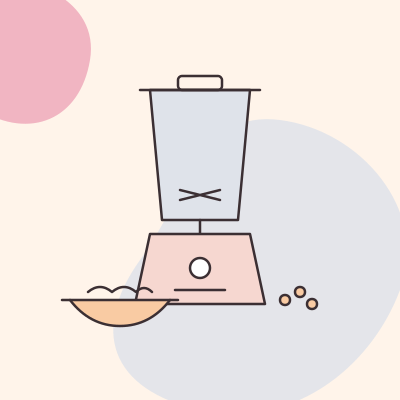
A few days ago I tried making pumpkin hummus for the first time. I should point out that my cooking skills are rather limited, or perhaps it would be fairer to say I’m not good in the kitchen because I’ve never bothered to spend any time on it. Anyway, I got down to it, and the recipe said “use a blender”. Naive beginner that I am, I told myself I only had a juicer and that it would come to the same thing, so that’s what I used. When I saw the result… and tasted it… I concluded that no, a juicer is definitely not the same as a blender. My first instinct was to get angry with the juicer (you heard me) before finally seeing sense.
Well, just as if I want hummus I have to follow the steps to make it, if I have a problem and want to get better, I have to listen to the professional I’ve chosen to see.
In therapy, we professionals know we can’t work at the same pace with every patient; that’s a fact and we have to adapt to it. Personally, I was trained in terms of effectiveness, efficiency and practicality, and that is something that quite strongly characterises the way I do therapy. A certain type of patient really likes this, while others find it harder to fit with. That’s why adapting to certain paces has perhaps been harder for me than for other professionals, and it’s something I try to train myself in day to day so I can adjust it with whoever needs it. As long as we keep working on the problem, respecting the patient’s pace is very important, as important as the strategies themselves, if not more. It’s a big lesson I’ve learned with time and experience, and, to be honest, one I still find hard in real practice today.
Then there are other situations that can be confused with what I’ve just described but are not really a question of working pace. Let me explain: sometimes, rarely in my experience, a patient comes to you with a goal (making homemade hummus), you explain the therapy (the blender), and the patient tells you they want to use their juicer, which is what they have at home (what they’re willing to give in therapy). At that point you can suggest a slower pace, work on motivation first, tell them about the possible future consequences of not working on the problem, look at whether there are other external or internal factors making therapy harder for them than for others… But despite all that, you may find the patient is still clearly and firmly set on making hummus with the juicer. And that’s where we hit a problem.
It’s as if someone wants to build muscle, goes to the gym and says to the trainer there: “Look, I want you to help me build muscle, but I don’t want to do any kind of weights or machines. I like the cross-trainer and I’d only like to do that. What intensity should I set it at and how long do I need to do it to reach my goal?”. If the trainer is good, as well as honest, they’ll tell them they can’t reach their goal that way, explain why and show them the right way to do it. In this case, choosing one option or the other is up to the client, but whichever option they choose, they ought to be consistent with it.
The patient is asking me for a goal but leaving me with my hands tied to achieve it. They’re not letting me do my job and, therefore, I can’t help them. And if it comes to that, my view is that you have to be kind but firm and make the situation clear; I think that’s the most honest way to see whether we can reach some kind of “negotiation”. If not, whenever this has happened to me I usually say the same thing:
“Look, I’d rather you came back in two months or two years, but ready to give it your all and willing to work”.
And sometimes, unfortunately, for that to happen the person has to hit rock bottom. It has happened, I’ve seen it more than once, and that’s when the patient comes back ready to give it everything, with or without fear by their side. The problem at that point is that we have to climb back up six floors instead of the three we had to climb the first time. That’s fine, we climb back up, but this time with a blender in hand.