Original article: Dr Sara Llorens, translated with AI.Read the original in Spanish
"I bet goats don't get OCD!"
A patient's remark opens the door to metacognition and the mental self: why we give OCD obsessions their power, and why we are not our thoughts.
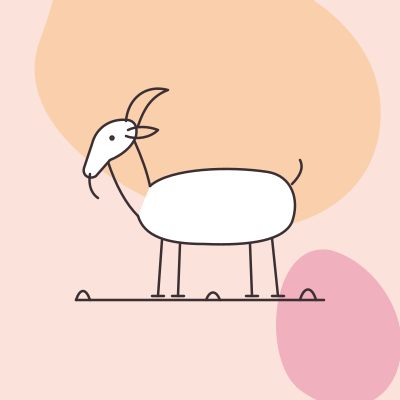
That’s what one of my patients with OCD said in our last session. I tried to hold it in, but I couldn’t help bursting out laughing, and he laughed with me. I’m not sure whether it was the remark itself or the way he said it, with a mix of good-natured envy and indignation at how lucky goats are. Sometimes it’s impossible not to laugh along with patients; moments of laughter in therapy are fairly rare, so they’re welcome when they come. A person’s smile is, and always will be, lovelier than their tears, and unfortunately I come across far more of the latter in my work.
He’s right: a goat doesn’t have OCD and never will, or any other mental disorder for that matter. That’s evolution for you, and in this particular case, cognition. Cognition is the human ability to process the information we perceive (from the outside world, from our inner world and from our life experiences): reasoning, intelligence, problem-solving, decision-making, attention, memory, learning, feelings (identifying, processing and explaining them…); all of these fall under what we call cognitive ability. While it’s true that some animals have been shown to have a degree of cognitive ability, those faculties are a far cry from the complexity of the human mind. That complexity has huge advantages; among other things, it has led us to rule the world (for better or worse). But the very cognitive ability that has given us an edge over every other living being also comes at a price. Today I want to focus on two terms: metacognition and the mental self.
“Goats don’t get OCD” because, unlike humans, they can’t think, let alone think about their thoughts. Welcome to metacognition. Metacognition is our ability to think about our own thoughts, that is, to interpret, reflect on, analyse, evaluate and judge our own mental world. We spend our lives thinking about our thoughts, but we often don’t notice because we’re on autopilot. We’re so used to doing it that we don’t realise. A person with OCD has the disorder because, among other things, they judge and evaluate their obsessions. They give them power. We’ve talked about this before: our thoughts (whether they come as sentences or words, images, urges or sensations) have no power in themselves. They’re nothing. Neutral. We give them power the moment we consider them important. OCD obsessions are powerful because the person gives them power by attaching a meaning to them (metacognition) that they don’t actually have. Obviously, that meaning has to do with threat: the obsession represents a threat to my health, my morals, my loved ones, my identity… If the person didn’t analyse their obsessions and give them a threatening meaning, there would be no OCD.
And here’s the second part: we’re so mental, so cognitive, we give so much importance to our mind because it’s so highly evolved (and, really, because it’s still largely unknown) that we make the huge mistake of identifying with it, that is, with our thoughts (and I’m not just talking about OCD here, though that too, but in general). We are not our thoughts. My mental self is only one part of my identity, not the whole. We’re much more than our mental activity and, what’s more, three quarters of what goes through our heads isn’t important. People with OCD identify with their obsessive thoughts because of this general human tendency to identify with what we think. We are what we think, what we do and what we feel. But we’re also what we think about the way we think, act and feel. And we’re also whatever we do to change what we are. And I could go on for quite a few more lines…
A goat has no mental health problems because it simply exists, in the here and now. Most of us have lost that ability to live in the here and now, to exist in the purest sense of the word. It’s something we can manage for a few minutes a day while meditating or in a moment of delight out in nature, to give a couple of examples, but our cognitive world and our ego (another advantage goats get from their lack of cognition: no ego) get in the way.
…Come to think of it, I actually understand my patient’s envy of the goats’ existence.