Original article: Dr Sara Llorens, translated with AI.Read the original in Spanish
Learn about yourself through the bonds you create
Your relationships can act as a mirror: how to move from judge to observer to understand your reactions and build healthier bonds with partners and family.
What matters in life is not the satisfaction of desire, but the revelation, through events and through our bonds, of what we never imagined we could become.
I heard this sentence the other day and it got me thinking, because the truth is that most of us live stuck in the first part, that is, in the pursuit of satisfying our desires. It is the ego that drives that pursuit, and the ego is usually a poor travelling companion. The ego always brings trouble and keeps us on the surface of things. Many of the problems that arise in the bonds we form (family, friendships, romantic relationships) appear because the other person does not live up to our expectations or wishes about how we think that relationship between them and us should be. We complain about the behaviour and attitude of our parents, partner, friends, siblings, children… because they don’t fit the idea we have in our heads of how that relationship should be. An idea we have built from our past, our experiences, character, needs, insecurities, desires… It’s as if, without realising it, we took for granted that the other person came into our lives with the duty of making us happy, and when we gradually discover that this isn’t so, out come the: “this isn’t working”, “you’ve let me down”, “I didn’t think you were like this”, “I feel disappointed”, “you shouldn’t do this / be like this / behave this way”, “you should have known”, “you need to change this and that…”, “I can’t go on like this…” and a long and varied etcetera.
This is a key point in many of the problems we have in our personal bonds, especially the ones we consider most important, since those are the ones we place the most expectations on. Our bonds with other people don’t exist to satisfy our desires; the other person doesn’t have to change, act or be a certain way so that I can feel happy, calm, safe… It’s true that, in one way or another, we all give in and adapt to some extent out of love (and when I say love, I mean any kind of love, not just romantic love), but there have to be limits, and it is essential that, as adults, we take responsibility for our own emotions. Our psychological and emotional world is each person’s own responsibility, not other people’s. Our needs are ours and we don’t have to project them onto others (whether it’s my parents, my child, my friend, my partner…). Communicating those needs so that we can be understood and therefore helped: yes. Loading the other person with the responsibility of meeting those needs: no. It’s very different. When we understand this, when we truly understand it, that’s when our bonds can become more real and of a higher quality.
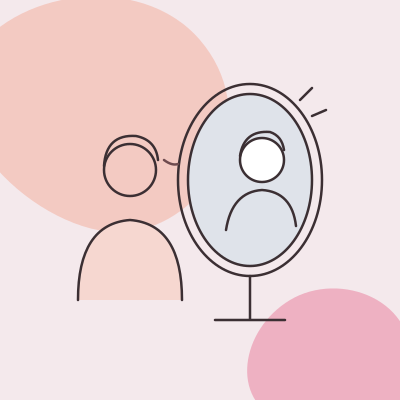
Once we understand all of the above, we can use the ties that connect us to other people to get to know ourselves better and reach our full potential. Because the truth is that everyone we cross paths with throughout our lives can act as a mirror, showing us traits of ourselves we didn’t even know were part of who we are, or helping us better understand our own reactions and personality. Relationships are there to be enjoyed, to learn about life and, above all, to learn about ourselves so that we can grow. However, that last part only happens if we take on the role of observer, not judge. An observer of ourselves and of the other person. Without judging their reactions, or mine. And you can’t be an impartial observer if the ego is sitting in the seat next to you.
All this may seem relatively easy when you read it, but it is incredibly hard to put into practice, because we live in a society that teaches us from the cradle to live from our fragile ego and defend it at all costs.
The next time an uncomfortable moment comes up (call it an uncomfortable moment, a conflict or a three-day argument where nobody’s talking…), instead of focusing on everything the other person did wrong, where they made a mistake (according to you, of course), what they’re lacking, what they have too much of… ask yourself questions, step into the role of observer and try to make the answers to those questions focus on the first person singular (which probably won’t be the first thing that comes to mind).
Ana’s case
Let me give you the example of Ana (let’s call her that). Ana contacted me from outside Valencia to do therapy online, and her main reason for seeking help was that she experiences her current relationship with a lot of anxiety and, according to her (and the records she sends me confirm it), her boyfriend isn’t the one responsible: she is. But she isn’t sure why, or how to handle it.
Here is one of the most recent situations. She started the session by telling me what had happened and asking questions such as: Why does he do this to me? Is it because he’s not really in love with me? Doesn’t he realise he’s hurting me? How can he not see it?
I suggested trying to answer a different kind of question, and we focused the session on those. Below are some of the answers she gave me as a judge, or with her ego by her side. And then the answers she gradually reached by herself when she took on the role of observer (which wasn’t easy for her).
Why am I reacting this way?
- Example of an answer from the ego: It’s that he told me we were going to do something together and then he didn’t call me. And he always does this to me! He doesn’t care about me, everything is more important than me.
- Example of an answer from the observer role: I think it’s because I feel insecure in the relationship. He’s super independent and I get the feeling that I’m always the one looking for things for us to do together.
Why is this affecting me so much?
- Example (ego): Because he always does the same thing to me and I’m fed up.
- Example (observer): Because the truth is I think I’m more in love with him than he is with me, and that scares me. It scares me because I feel at a disadvantage and that bothers me.
What does my reaction say about me?
- Example (ego): Nothing about me, it’s his fault. That’s all I needed!
- Example (observer): That I am insecure and I’d like to spend more time with my partner.
Would I feel the same if this had happened with someone else? Why?
- Example (ego): I don’t know, what does it matter. It happened with him, end of story.
- Example (observer): Well, I don’t think so. It only happens to me with him because he matters more to me… If one of my friends had done it, maybe I would have been more understanding. I mean, I wouldn’t have liked it, but my reaction wouldn’t have been the same, because you always expect more from your partner than from your friends, right?
Does this situation remind me of earlier ones? What do they all have in common?
- Example (ego): I don’t know, right now I can’t think about anything else.
- Example (observer): Well, yes, it has happened to me in other relationships and it was always a source of conflict. It happens more with him because, since he’s more independent than my exes, I feel even more insecure. It’s also true that years ago it used to happen with my best friend when she went out with other friends of hers I didn’t get on with very well… but that was before I had a partner.
At the start of the session, Ana’s plan was not to speak to her boyfriend until he realised she wasn’t OK and, when that happened, “talk to him so he realises how little he cares about me and that he can’t be in a relationship being like that”. By the end of the session, Ana had decided to call him to meet up and tell him that what she needed from him was to see each other more often. That she understood he was very independent and that this didn’t mean he didn’t love her, but that she, in turn, needed certain things from him and they had to talk about it.
I’ve used Ana’s case, which was about a couple, but I could just as well have illustrated it with a mother-child relationship, siblings, a pair of friends… It doesn’t matter: everything written above applies to all kinds of human relationships. If we manage to do what Ana did more often with our important relationships, we’ll be much better with ourselves and with others. We’ll have more inner peace, which, after all, is what we all want. To be at peace with ourselves and with the people who matter to us.