Original article: Dr Sara Llorens, translated with AI.Read the original in Spanish
The art of letting go
Why is it so hard to walk away from jobs, relationships or ideas that hurt us? The two stages of letting go: making the decision and sticking to it.
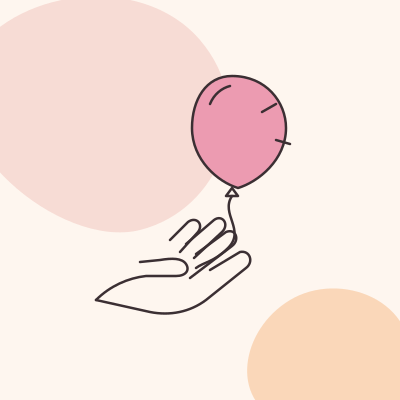
Many of the people who come to therapy do so because of everyday issues that, for one reason or another, have festered until they’ve become torture for whoever is living through them. One of the most common problems in these situations is how incredibly hard human beings find it to let go. Releasing our grip costs us dearly. More often than we’d like, we form bonds so strong, sometimes real and sometimes imagined, that they tie us to situations, people, jobs and ideas, however damaging they may be for our mental health. It happens with all sorts of situations: a job we don’t like and where we’re not valued, toxic friendships, ideas or plans about how we’re supposed to live our lives, relationships… We don’t let them go because of insecurity, fear and the very low tolerance for uncertainty that most of us share.
Letting go is an art in itself, and it involves two very clear stages:
Stage 1 is making the decision. Leaving or letting go involves a decision, and for the person concerned that can feel like a mountain to climb. Making decisions involves risk, and that isn’t always easy to accept, especially when feelings are involved. Here are examples from three patients whose words capture what I want to explain:
Pablo (8 years in a job he doesn’t like and where he doesn’t feel valued):
If I leave my job I could try to set up something of my own, something I’d enjoy and feel excited about. Or I could apply to another company that values me more, but it’s also true that I might fail… I might regret taking the leap… and that possibility leaves me frozen. What if I get it wrong? What if things go badly? I feel trapped, and it’s because I’m a coward.
Diana (who has been trying to become a mother for 6 years with Mario, her partner of 10 years):
I’ve always wanted to be a mother; I can’t imagine life without it. Mario and I have been trying for years, doing everything possible, spending most of our savings, and with every failed attempt we sink lower. We’re devastated, we can’t go on, but if I give up on the idea, what will become of our life? What if I can’t be happy? What if Mario changes his mind in a few years? I’m terrified that we won’t be enough for each other, that he won’t be happy because I couldn’t give him a child. I don’t want to give up, but I’ve felt at my limit for a long time now.
Verónica (with her partner for almost a year and a half, and full of doubts from the very start):
I don’t know what to do. I love him, but I know we have no future together. We come from two different worlds; in the long run there’s nothing to be done. I keep telling him this isn’t going to work, but I can’t bring myself to end it either, because in many ways he does make me happy and I’ve been better since I’ve been with him. I’m afraid of leaving him and then being worse off, or going back to how I was before I met him. If I’m honest… I’m also afraid of being alone.
Once we manage to make the decision, which can take months (if not years), we move on to stage 2: sticking to the decision. Not going back, not wavering back and forth. We spend much of our time looking in the rear-view mirror. Stage 1 needs to be worked on thoroughly so that stage 2 is easier to carry out, difficult as it is.
Take Silvia’s case, for example. Silvia had been in therapy for 6 months after a breakup she’d handled badly, following 7 years with her ex-partner. The reasons for the breakup don’t matter here, but the conclusion we reached was that he couldn’t make her happy because their needs and personalities were incompatible. We met once a fortnight, she worked hard, circumstances were on our side and she soon began to improve. On the day of our last session she told me (with that typical smile a patient has when telling you something they know goes completely against everything you’ve worked on together…) that she’d been in touch with a friend of her ex and was thinking of meeting her ex for coffee to “see how everything was going”. We both knew it was a terrible idea in this case and that, in reality, she wasn’t ready. The conversation could be summed up like this:
Silvia: So, yeah… I’m thinking about it. What do you think?
Me: What’s the goal of meeting up?
Silvia: Like I said, to see how he’s doing and, you know, that sort of thing.
Me: Try to be honest with yourself, and if that really is the only goal and you feel ready, then go ahead. Though I don’t think it’s a good idea. Think about what you really want from this move, and also about whether you’re truly ready.
Silvia: Silence and a smile.
Me: You’re going to do whatever you want, because it’s not my place to tell you what to do, but I will say that it’s taken a lot to get here and you’ve had a really hard time. It’s worth at least thinking it over before you make that move.
Silvia: If I think it through, I know I’m not ready and that seeing him is a big risk. But talking to his friend brought back memories, and now that I’m stronger… Besides, what if I bump into him one day? I can’t be afraid of seeing him, can I? We’ve been working to make me stronger, not to make me hide.
Me: True, but there’s a difference between hiding and walking into the lion’s den. You’ve already cut ties with him on almost every level. If you meet him, you’ll be going backwards and you risk losing everything you’ve gained. Maybe that won’t happen, but either way you need to weigh up whether it’s worth it. If you keep looking back, you’ll never give yourself the chance to see what lies ahead.
Silvia wrote to me a few days later to tell me she’d decided not to see him, and I have to say I was glad, because the alternative would have ended in emotional chaos.
Bonds are essential in human life; but knowing when to break them is just as important as creating them.