Original article: Dr Sara Llorens, translated with AI.Read the original in Spanish
What Is Traumatic Paralysis (Psychic Sideration)? Part 1
Why some victims of assault freeze: what psychic sideration is, how it differs from dissociation and what happens in the brain during trauma.
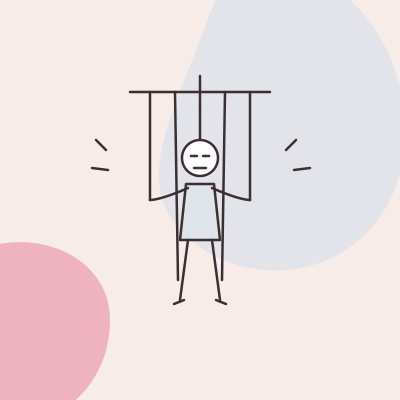
Psychic sideration is a phenomenon that occurs in traumatic situations, especially sexual assaults. “Sideration” means “paralysis”. Sometimes, when a person goes through a situation so traumatic that their brain is unable to process it, a psychological paralysis occurs, which in turn causes a physical paralysis. Let’s say the brain stops working in those moments and we become something like a rag doll, a puppet, which makes it much easier for the attacker (in the case of a sexual assault, for example) to do whatever they want with us. In those moments, the fear is so overwhelming that our brain shuts down. Just like that. Obviously, this leaves the victim completely incapacitated.
It’s important to distinguish clearly between sideration and dissociation. As I said, the first is a paralysis that leaves the victim unable to react, whereas dissociation is an emotional disconnection which, in these cases, comes after sideration and makes the victim experience the situation in the moment as something surreal, detached from any kind of emotion. Both are defence mechanisms of our brain. Why? Let me explain.
When a traumatic situation occurs, the amygdala sends levels of adrenaline and cortisol soaring in the brain – these are the substances released in stressful situations. They’re released to prepare the body to flee (in evolutionary terms, stress signals a threat to the brain, and the brain prepares the body to escape it). The problem is that if the attacker holds the victim down, escape isn’t possible, but those substances build up and overload the body. According to the model proposed by the psychiatrist Muriel Salmona, this excess stress would pose a risk to the body (for example, to the cardiovascular system) and, to protect itself, the brain would release its own substances with effects similar to those of morphine and ketamine (such as endorphins), which cause a kind of brain short circuit. It’s a very useful explanatory model, although not all its details have been confirmed by research. As a result, the victim stays alive but enters a second phase, dissociation, as if leaving their body and watching the situation from outside. Sideration is a defence against a physiological problem, whereas dissociation is a defence against psychological harm.
The freezing response to extreme threat (known in the scientific literature as tonic immobility) is well documented, and MRI scans show changes in brain activity linked to trauma. If, during the scan, we have the person relive the traumatic situation (with photos, accounts or videos), we can see the amygdala become highly active (it lights up in colour) while activity drops in other areas, such as parts of the prefrontal cortex and the language areas.
All this also has important consequences later on when it comes to remembering the trauma, because these phenomena affect the hippocampus (the area of the brain where memory is integrated): its functioning is disrupted, so the victim finds it very hard to remember the events, as they haven’t been integrated as they should have been. Let’s say the time-and-space framework becomes very blurred, leaving the person unable to remember what happened with any precision.
All this is basic, essential knowledge to bear in mind, because a lack of awareness about it can lead to the victim being wrongly judged – people may think that if they didn’t fight back tooth and nail, it’s because they actually consented. Or that, because they can’t remember what happened, they’re lying or making it up. When the reality is that their behaviour is the result of a whole series of psychological processes in human nature that are completely beyond their control and, in many cases, beyond their own understanding – many victims feel enormous guilt because they misinterpret their own lack of reaction to the situation. Not understanding how the human brain works in these cases can lead victims themselves to wonder whether they “did something wrong”.
There are a few other points related to this that I think it’s important for you to know, so I’ve devoted a second part to them, to complete the picture of what this phenomenon means and… its impact at every level.