Original article: Dr Sara Llorens, translated with AI.Read the original in Spanish
Attachment styles and their link to trauma
Secure, avoidant, anxious and disorganised attachment: how they differ and why disorganised attachment raises the risk of trauma.
Today I’ve got a new recommendation for you. A good friend and fellow psychologist suggested the book, and it was spot on: The Body Keeps the Score by Bessel van der Kolk. I recommend it because, besides being a good book on trauma, I think it’s written with great sensitivity and a good dose of empathy. The author walks you through the various research advances on trauma, the physiology of the traumatised brain, trauma in children and adults, and the most recommended treatments for these situations (some more traditional than others). All of it with professionalism, warmth and kindness. That may sound like a small thing, but it isn’t: it’s not easy to communicate topics like these in that way.
In my opinion, every page of the book is worth reading. And given the way it’s written, I don’t think you need to be a professional in the field to read and appreciate it.
I could tell you about many of the points I found interesting, but I want to focus on the relationship between attachment and trauma. In another article I discussed the link between disorganised attachment in childhood and the development of dissociative disorders (remember: dissociation is very common in people who have been traumatised), and today I’d like to go a little deeper.
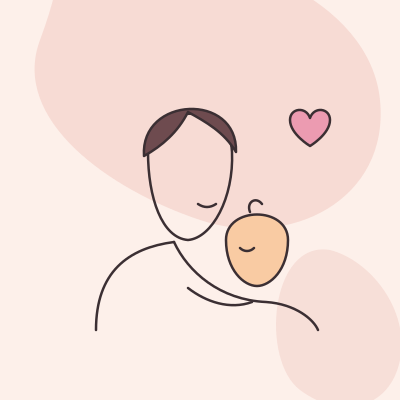
Broadly speaking, we could define attachment as the emotional bond that develops between a child and their parents. Attachment is instinctive, because the child needs their parents to survive. Which type of attachment develops is key, and it tends to persist over the years, influencing the kind of relationships we form as adults. There is organised attachment and disorganised attachment. Organised attachment includes three categories: secure, avoidant and anxious attachment. These three organised categories work because the child receives the best care their parents are able to give in each case, although avoidant and anxious attachment will probably lead to some problems later on. Let me explain the three categories in a little more detail.
Secure attachment is the kind every child should have. Here, parents combine care, protection and comfort while gradually helping the child develop their own skills. This type of attachment creates an internal locus of control in the child, which helps them tell apart situations they can handle on their own from those where they need to ask for help. These children learn that if they ask for help, they’ll get it. In secure attachment, the child cries when their mother leaves but shows calm and joy when she comes back.
Unlike secure attachment, in avoidant attachment children seem unaffected when their mother leaves and show no joy when she returns. However, studies have observed that these babies’ heart rate does change, even if they don’t show it. In fact, their heart rate is very high, which suggests these children are highly aroused inside, even if they don’t show it. It has also been observed that mothers who form this type of attachment with their babies don’t tend to stroke or hug them, nor do they use facial expressions to communicate. Children with this type of attachment are more likely to grow into adults who struggle to recognise and express their feelings and to connect with other people’s.
Third comes anxious attachment, in which the baby constantly seeks the mother’s attention through crying, screaming, tantrums… As if they needed their mother’s presence at all times, above anything else. As in secure attachment, these children become very distressed when their mother disappears, but the difference is that here the child doesn’t seem to calm down when she comes back. These children are more likely to grow into anxious adults, especially in their relationships, with a fear of abandonment and a strong need for reassurance.
Then we come to disorganised attachment which, as I mentioned, is the type most often found in people with dissociative disorders. In disorganised attachment, the child finds no protection, calm or comfort in the adult, because the main caregiver is the very source of the child’s distress or fear. If the person who’s supposed to look after and protect me is precisely the person who terrifies me, who do I turn to? That’s the crux of it: I’m afraid and I can’t ask for help. Many children with this type of attachment become aggressive or show a general lack of interest, and they often develop psychological problems.
Physiologically, they show higher cortisol levels (the well-known stress hormone), a weakened immune system and a chronically higher heart rate. Sadly, it has been observed that this physiological imbalance can persist for quite some time even when the child is moved to a safe environment; that said, a stable environment and good intervention can help regulate it little by little.
Children with this type of attachment are often raised in families where there is physical and/or psychological abuse, sexual abuse… But sometimes it also happens without any of this, when the parents themselves are traumatised (by the death of a relative, a rape or any other traumatic event the father or mother hasn’t recovered from) and this prevents them from forming a proper bond with the child.
In any case, a child or adult with disorganised attachment is more likely to develop post-traumatic stress disorder (PTSD) and to find it harder to recover from that trauma than a child or adult raised with secure, avoidant or anxious attachment, especially secure attachment.
If you’re interested in trauma, I warmly recommend this book. Either way, we’ll come back to this topic in future articles.