Original article: Dr Sara Llorens, translated with AI.Read the original in Spanish
Do we really know how to communicate?
We talk a lot, listen little and stay silent for fear of rejection. Why we communicate worse than we think, and how to start changing it.
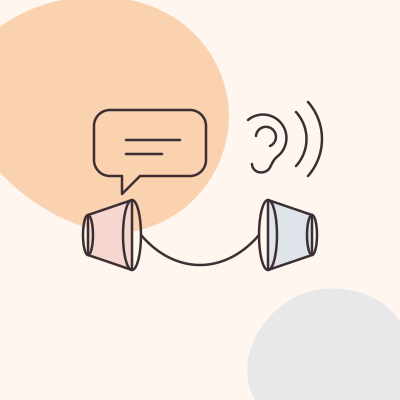
“I’m more and more amazed at how much people talk and how little they actually listen. Sometimes, when I’m on the phone with a friend, I think that if I put my phone down on the table for half an hour, the person on the other end would carry on talking without even noticing. I feel that a lot of people are only interested in talking about themselves, with no real interest in the other person.”
Amaya
Anabel has just split up with her partner after six years together. She’s quite low and overwhelmed, not so much because of the break-up but because she knows that her parents’ priority is to see her living a “stable, secure” life, and in Anabel’s family that means one thing: in a couple and with children. “I feel I’m letting them down. I feel responsible for their happiness. They want to be grandparents and I know my brother doesn’t want to be a father, so I’m their only chance. All the responsibility falls on me, and I don’t even know if I want to be a mother! I feel a lot of pressure because I’m not living the life I’m supposed to be living. In my family we’ve always been told your life isn’t complete unless you’re with someone and start a family.” Tears were running down Anabel’s face as she spoke. She would like to tell her parents how she feels, but she thinks it would hurt them, so she keeps it to herself.
Juan left Marta overnight, without any explanation, after three years together. The truth is that Juan is in love with Marta, but he has quite a few problems of his own, starting with bipolar disorder, which little by little is showing itself more sharply. He could have told Marta the truth and asked for her support, but he was afraid she would reject him once she knew about his problem, so he chose to simply leave her, knowing she would be devastated.
Patricia: “I wish my mum understood that I’m taking on responsibilities that aren’t mine at my age; they’re too much for me. I know my mum is on her own because we can’t count on my dad, but I’m drowning. I cry every night and I’ve started skipping classes again… And I’ve gone back to bingeing and making myself sick. And I don’t want to tell my mum how I feel because I want her to know she can count on me. I don’t want her to feel alone, but the truth is I’m at breaking point.”
Pedro: “I miss my children a lot and I’d like to see my grandchildren more. I’d love it if they visited me more of their own accord. I don’t want to say anything because I don’t want to be a burden.”
María notices that every time she talks to Paula to tell her about something important that has happened to her, Paula has a strong tendency to project, so that 90% of the times María tries to share something, they end up talking about Paula’s life without Paula even realising. María doesn’t dare say anything to her friend for fear of upsetting or hurting her, but at the same time she notices that she shares less and less of her life with her because, when she does, she doesn’t feel heard.
Supposedly, our ability to reason and our use of language not only set us apart from other animals but make us the most intelligent of them. It’s true that we have mastered the use of language, but the quality of our communication is another story. The reality is that we communicate rather badly. Not everyone, of course, and not always, but our communication leaves a lot of room for improvement.
Very often, when we communicate, we manipulate; we lie; other times we avoid saying what we think and feel for fear of rejection, of disappointing, of anger, of making the other person sad; we hide things and keep quiet for fear of being judged; we talk too much and listen very, very little… We pay little attention to what we’re told because we’re too busy with ourselves, with what we think, what we feel, what we’re going to say next. Often we don’t notice the other person’s body language either, which is shouting at us what perhaps they don’t dare, or don’t know how, to say in words. Staying quiet while someone talks doesn’t necessarily mean I’m attending to them and listening with genuine interest, because if I’m only waiting for them to finish so I can tell my own story on the subject (the same thing happened to me that time…), then it isn’t active listening. Very often we talk a lot and say very little; sometimes we can’t put into words what we think or feel because we’re not clear about it ourselves…
We all know that between actions and words, actions usually win. Actions are what prove the most, and they are obviously another way of communicating. If you don’t know how to say it in words, show it with your actions. Yes, but words are still very important. What we do matters. What we say matters too. And how we say it.
A lack of communication leaves a lot of room for interpretation, and that can lead to many problems, both with ourselves and in our relationships with others. Everything we need to communicate and don’t (or do, but badly) builds up and leads to varying degrees of somatisation, to resentment, to self-esteem problems, to growing apart from people we love, to feelings of loneliness and of being misunderstood, to outbursts of anger, to break-ups, to poor decisions, to missed opportunities… and so on. Not to mention the role it can often play in the development and maintenance of more serious disorders.
If you recognise yourself in what I’m telling you today, here’s a small exercise: think of a situation in which you’d like to communicate differently from the way you have been so far (maybe something to do with your partner, your boss, a friend or a colleague… or maybe with your local baker or the newsagent, it doesn’t matter, whichever you like) and set yourself the challenge of trying to change it over the next few days. Start with something very simple. And notice whether that small change, invisible to the rest of the world, has any effect on you and on the person you’re communicating with.
I’m not one for self-help books at all, either personally or for my patients. However, there are exceptions to everything, and almost every time I work on assertiveness in therapy I recommend Olga Castanyer’s book La asertividad, expresión de una sana autoestima (“Assertiveness, the expression of healthy self-esteem”, available in Spanish). There are hundreds of books on communication skills, but this one, although it has a few years behind it, is a particular favourite of mine because of how approachable it is, the many everyday examples the author uses to illustrate her points and the short exercises it includes to practise what she explains (very well explained, by the way). I often use it as one more working tool with patients who need to improve how they communicate, and the general opinion of the book tends to be very positive. If you read Spanish, I encourage you to have a look if you want to improve the way you communicate with the rest of the world.