Original article: Dr Sara Llorens, translated with AI.Read the original in Spanish
Kintsugi
A ficus that survived a parasite and the Japanese art of mending with gold: why, after overcoming a problem, you're not the same but stronger.
In this life there are people who are good at looking after plants and people who manage to kill even cacti. I’m in the second group. When I moved into my current practice, a relative decided to give me several plants for the office. I felt sorry for them from the start, because I was convinced I knew how they’d end up, however hard I tried to look after them. To my amazement, all three have survived the four years I’ve been in this office. Honestly, I didn’t think that was possible.
Of the three, my favourite is the ficus on the terrace. It’s not particularly pretty, but I’m fond of it because it’s a survivor. A year ago it started looking awful, it lost almost all its leaves, and I asked the person who’d given it to me what was wrong with it. They told me it had a parasite, that nothing could be done and that it was dying. They suggested I throw it away and buy another one. I felt sad… That ficus had been with me since the very beginning of my practice. Call me sentimental, but I refused, and told myself I’d wait until its very last leaf had withered, just in case.
And over time it seems my ficus turned out to be stronger than its parasite, because new little leaves started to sprout and it got its colour back. Today it’s perfectly healthy. You couldn’t say it’s the prettiest or the bushiest, but it’s certainly a survivor, and in my eyes that makes it special. When I look at it I feel proud, and I tell myself we all have our quirks, because I don’t think many people feel “proud of their plant”. Or maybe they do. Who knows…
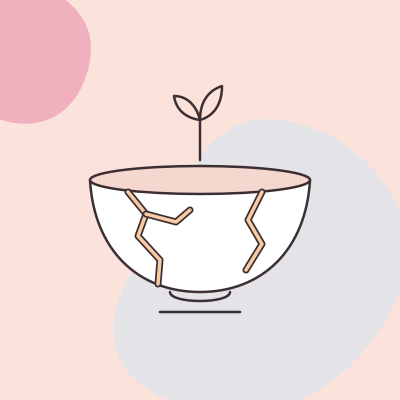
In Japan there’s a technique called kintsugi, the art of repairing objects with gold dust, so that the broken and mended object takes on a new look that highlights the value and beauty of those repaired fractures, of its scars. What is a technique for restoring works of art and the like actually represents a philosophy of life that aims to show us the value of the battle scars we earn in the fights we go through, which turn us into a stronger version of ourselves. Marks that, visible or not, increase our worth as human beings. Or as living beings… because there’s my ficus to set an example.
In general, we humans like to live a quiet life, free of problems. We believe that as long as “nothing happens to us”, all will be well and we’ll be reasonably happy. Obviously this is partly true, and that’s great: if you don’t have (or haven’t had) problems and you’re happy too, good for you. But for better or worse, life is a constant challenge that tests us at many points, and it does so however and whenever it pleases. That’s when we have to show our strength. Many of my patients ask me whether they’ll ever be the same again, because they believe they’ll never get out of the hole they’re in. I believe that when we come through a fairly serious problem, we can’t be the same person as before. We have an extra experience that has left its mark, and if we’ve managed to overcome it, it’s very likely because we’ve learnt resources, discovered things about ourselves and taken life lessons from that experience.
My ficus will surely have a stronger immune system now than before the parasite: that renewed, stronger immune system is my plant’s gold dust. What you learn about yourself in the arena, the lessons life teaches you while you fight, and the resources you acquire and train to win the battle are what turn you into a phoenix. So no, you won’t be the same, but a renewed version of yourself: stronger and wiser.