Original article: Dr Sara Llorens, translated with AI.Read the original in Spanish
When Do We First Become Capable of Feeling Jealous?
Can babies feel jealous? Some studies say yes, from around 6 months. What jealousy is, how a baby shows it and what purpose it serves.
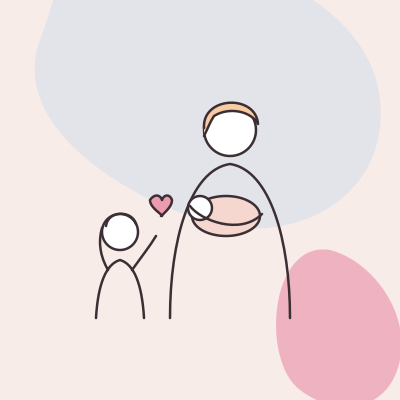
On the one hand there are the emotions we call basic (fear, sadness, joy…) and, on the other, those we call “complex” (jealousy, shame, pride, guilt…). The latter are thought to be a mix of two or more emotions from the first group. According to some theories, complex emotions are acquired later in life, once we develop the cognitive resources they require. Well, today I’m going to focus on jealousy from a particular angle. Contrary to what I’ve just said, some theories argue that we’re able to show jealousy at a very early age because of our innate tendency to resist social exclusion. Let’s see what this means in practical terms and how researchers in the field explain it.
Darwin said that emotions are essential for survival because expressing them creates an interaction between a person and their environment. Expressing our emotions, especially at a very early age, increases our chances of survival. And, according to some studies, expressing jealousy would also help us in this respect.
Remember that jealousy is the emotion we feel when we perceive that a third party is threatening a close relationship we have with someone else. It doesn’t have to be a romantic relationship: we can talk about jealousy in many kinds of relationships – between siblings, between friends, between colleagues… This emotion can show itself at different levels: cognitive (the way we think) and behavioural (the way we act).
Some studies, such as those by the researcher Sybil Hart, suggest that by around 6 months of age babies already show an early form of jealousy when they feel their relationship with their main caregiver(s) is under threat. Some authors point to even earlier ages, although the evidence there is more limited. How does such a young baby show jealousy?
- On the one hand, through behaviours that show their separation anxiety (crying, refusing to eat…).
- On the other, through behaviours aimed at regaining their caregiver’s exclusive attention (looks, calling vocalisations…).
To understand the neural basis of jealousy, you need to bear two things in mind:
- Babies’ innate tendency to establish and maintain exclusive relationships with their caregivers.
- The socio-cognitive processes linked to emotion regulation.
As I mentioned, when a baby feels their relationship with their caregiver is threatened by a third party, they respond with negative emotions, because this goes against their innate tendency to keep that relationship exclusive, and they start attention-seeking behaviours to win it back. Alongside these behaviours, corresponding changes take place in the baby’s body: the negative emotional response intensifies because of the rise in stress hormones that occurs in this kind of situation. Paradoxically, stress increases social motivation through the release of dopamine, oxytocin and opioids. These substances help reduce the stress and negative emotions the baby feels, restoring the neural networks involved in emotional bonds.
In fact, we could say that jealous reactions are an adaptive response in babies that ends up strengthening the exclusive emotional bonds they have with their caregivers. This makes sense: a threat is perceived, there’s a primary reaction, and the body responds to restore order and avoid an excessive reaction. The body is trained to respond quickly and effectively to what it perceives as threats to survival.